














Agartala, August 26:

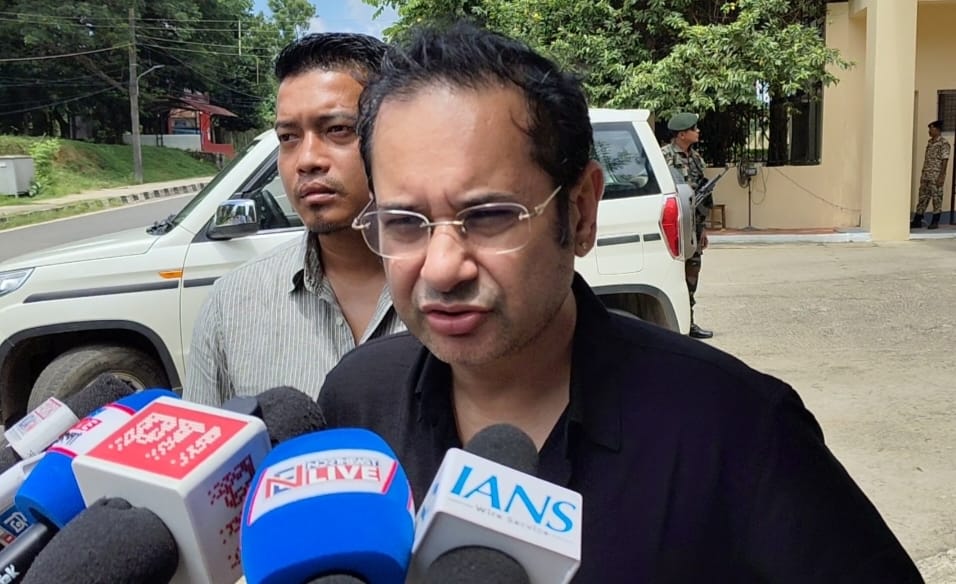
TIPRA Motha supremo Pradyot Kishore Debbarma on Wednesday stepped up pressure on the BJP-led government over the long-pending legislation of the Tripura Tribal Areas Autonomous District Council (TTADC), saying the interests of the state’s indigenous people cannot be sacrificed for political considerations and indicating that continued inaction could force him to reconsider the NDA alliance.
Pradyot made the remarks after meeting Governor Indra Sena Reddy Nallu at Lok Bhavan here, accompanied by TTADC Chief Executive Member Runil Debbarma.
The meeting focused primarily on a number of bills passed by the elected autonomous council over the years that, according to Pradyot, have not reached the Governor for assent.
The intervention comes at a politically sensitive juncture, with the BJP and TIPRA Motha facing growing differences over the implementation of the March 2024 tripartite agreement, the powers of the tribal autonomous administration and other issues concerning indigenous interests.
The differences assume added significance ahead of the village council elections and the forthcoming session of the Tripura Legislative Assembly.
“I wanted to get an update on the bills that we have sent to the Governor, passed over the years by the district council, which are yet to get his assent,” Pradyot said.
He said the TTADC had passed some 18 bills covering land, administrative reforms, recruitment policy and customary laws, but they had remained pending for years.
According to Pradyot, the council does not directly send the legislation to the Governor. The bills are routed through the state government’s Tribal Welfare Department, the nodal agency, which is then required to forward them to the Governor. He alleged that in several cases the state government had not forwarded the bills to the Governor at all.
“If the bill does not come to the Governor, how will the Governor sign it?” he asked.
Pradyot said he had submitted a written representation to the Governor, seeking an explanation for the prolonged delay and urging him to inquire with the state government about the status of the bills.
He claimed that 18 bills dating back to 2007 were still caught in the process and said the issue had also been raised before the Supreme Court.
Referring to the Supreme Court’s observations in the Tamil Nadu Governor case, Pradyot said a Governor could not sit indefinitely on legislation. At the same time, he pointed out that the procedural route in Tripura was different because ADC bills were required to pass through the state government before reaching the Governor.
The TIPRA Motha chief said the prolonged delay was also creating a political dilemma for elected ADC representatives.
“People question us—‘We voted for you, but why have you not passed laws for us?’” he said, adding that the council was an elected institution and had a responsibility to deliver on its legislative mandate.
The Governor, according to Pradyot, told him that “things are being sorted out”. Pradyot, however, said he had not yet received concrete information on when the pending legislation would move forward.
The issue has now acquired a direct political dimension.
Pradyot said he did not want to engage in what he described as “politics” while people questioned his intentions and his failure to deliver the commitments he had made to them.
“If the Government of India and the state government do not give our people the rights of Tripura self-government, I cannot go to the people and talk about the alliance,” he said.
At the same time, he defended his position against criticism from opposition leaders, saying political parties would naturally attack him because TIPRA Motha was currently in alliance with the BJP.
“It’s politics,” he said, adding that if he were to leave the BJP-led alliance in future, the political narrative would change and those same parties could invite TIPRA Motha into their fold.
But Pradyot sought to place the debate beyond party politics.
“If we are all Indians, we have to think about our state. Should we think only about my party?” he asked.
He said his priority was the people of Tripura rather than the political fortunes of TIPRA Motha.
“I don’t want to be remembered as a good politician. I want to be remembered as a good human being,” Pradyot said, stressing that honesty required him to speak what he believed was in the interests of the people.
The remarks are likely to further intensify speculation over the future of the BJP-TIPRA Motha alliance. Pradyot said TIPRA Motha remained an independent political party and that its alliance with the BJP was based on the Tripura Accord, but made it clear that the alliance did not prevent the party from raising issues concerning the people.
He also disclosed that TIPRA Motha MLAs would meet separately on Wednesday evening to decide the party’s strategy.
With the village council elections approaching and the Assembly session scheduled to begin shortly, the meeting assumes significance as TIPRA Motha seeks to demonstrate that its participation in the ruling alliance does not mean surrendering its core political demands.
For the BJP, the challenge is to contain growing friction with its tribal ally while retaining the alliance ahead of the electoral test. For Pradyot, the pending ADC legislation and implementation of the tripartite agreement have increasingly become measures of whether the alliance can deliver on the political assurances made to Tripura’s tribal population.