
















**Agartala, June 20:** Agriculture and Farmers’ Welfare Minister Ratan Lal Nath on Friday reiterated the commitment of both the Central and State governments towards empowering farmers, rural communities, youth, and women, stating that inclusive development is essential to realizing the vision of **“Ek Bharat, Shreshtha Bharat.”**

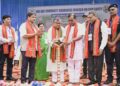
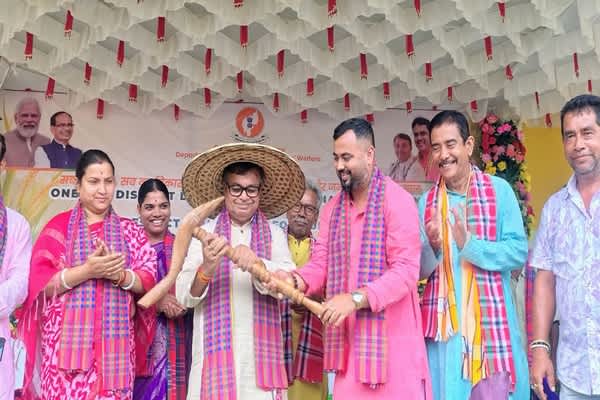
The Minister was addressing a **District-Level Workshop on Natural Farming** organized under the *Khet Bachao Abhiyan* at Madhumala SB School in KK Nagar, Bishalgarh. The programme brought together farmers, agricultural experts, public representatives, and government officials to discuss sustainable farming practices and strategies for strengthening the agricultural sector.
Speaking on the occasion, Nath described agriculture as the backbone of India’s economy and emphasized that sustainable growth and national development cannot be achieved without improving the welfare of farmers. He highlighted a series of flagship schemes introduced by the Government of India, including the **Pradhan Mantri Kisan Samman Nidhi (PM-KISAN)**, **Pradhan Mantri Fasal Bima Yojana**, **PM Kusum Scheme**, and the **Soil Health Card Programme**, which aim to enhance agricultural productivity, boost farmers’ income, and encourage environmentally friendly farming practices.
The Minister stressed that natural farming has emerged as an important tool for ensuring long-term soil health, reducing production costs, and promoting sustainable agriculture. He encouraged farmers to adopt natural and organic methods to improve both productivity and environmental conservation.
Highlighting broader welfare initiatives, Nath said that schemes such as **Ayushman Bharat** and **Pradhan Mantri Awas Yojana** have significantly improved the quality of life in rural areas. He noted that more than **four lakh houses** have been provided to beneficiaries in Tripura under the current government, compared to around **72,000 houses** constructed during previous administrations. Additionally, over **6.48 lakh households** have received free drinking water connections, while free ration distribution has provided further support to economically weaker sections.
Reflecting on India’s agricultural progress, Nath remarked that the country, once dependent on imports of rice and wheat, has now become a grain-exporting nation. He credited farmers for this transformation and said Prime Minister Narendra Modi envisions India becoming a global hub for grain storage and food security.
The workshop, attended by MLA Sushanta Deb and other dignitaries, featured discussions on natural farming techniques, sustainable agricultural practices, and the role of government schemes in improving rural livelihoods and ensuring long-term agricultural resilience.