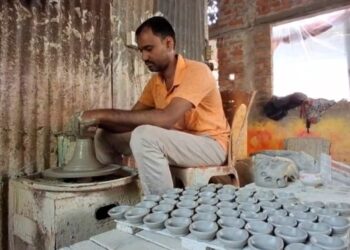




















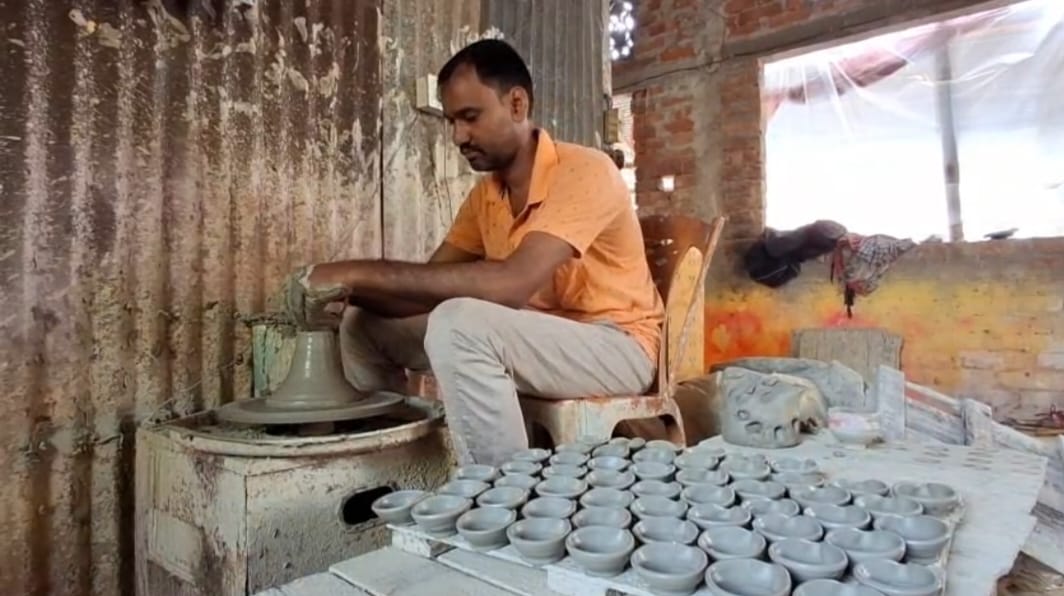
Agartala, Nov 6: From contemplating abandoning a centuries-old family occupation to working almost round the clock to meet a surge in demand for earthen lamps, pottery artisans in Tripura’s Nandannagar area on the outskirts of Agartala are witnessing a remarkable turnaround, crediting government support and the ‘Vocal for Local’ campaign for reviving their traditional trade.

As Diwali approaches, the potters of Palpara are struggling to keep pace with orders for earthen lamps and other clay products. Artisans say demand has increased several times compared with a decade ago, when the influx of Chinese decorative lights, candles and cheaper plastic alternatives had pushed traditional pottery to the brink of decline.
“We were thinking of leaving this occupation and moving into other professions around eight to ten years ago. There was hardly any demand for our products, particularly earthen lamps during Diwali. People had shifted to Chinese lights and candles,” Biswajit Rudra Paul, one artisan said, recalling the difficult period.
The change, they said, began with renewed government attention towards traditional artisans, including training programmes, financial assistance and the introduction of mechanised production.
Earlier, potters had to prepare clay and operate traditional wheels manually. Government-provided electric pottery wheels, clay-processing machines and technical training have now made production faster and less physically demanding, allowing artisans to increase output and involve more people in the trade.
Another artisan, Ajit Rudra Paul, said the ‘Vocal for Local’ initiative had helped change consumer preferences and brought traditional earthen lamps back into the market.
“Earlier, our lamps hardly sold. With the government’s call for ‘Vocal for Local’, people have become more conscious about supporting local products. We have been able to utilise that opportunity, and demand has increased many times. We are now working day and night but still finding it difficult to fulfil all the orders,” he said.
The revival has also created employment opportunities, particularly for women. Artisans said nearly 100 women in the Palpara pottery cluster had joined the occupation following government-supported training and the distribution of machines, enabling many to work from home. Some women can earn between Rs 1 lakh and Rs 1.5 lakh annually, depending on their production and sales.
The benefits are extending beyond individual households, with younger people, including educated youth, also showing interest in the occupation.
Apart from providing livelihoods, artisans believe the growing preference for earthen products offers an environmentally friendly alternative to plastic and other non-biodegradable decorative materials.
For the potters of Palpara, Diwali has therefore become more than a seasonal business opportunity. It represents renewed confidence in a traditional craft that once faced the prospect of disappearing but is now offering livelihoods to a growing number of families.
As orders continue to pour in, their immediate challenge is no longer finding buyers but producing enough lamps to meet the festive demand.