


















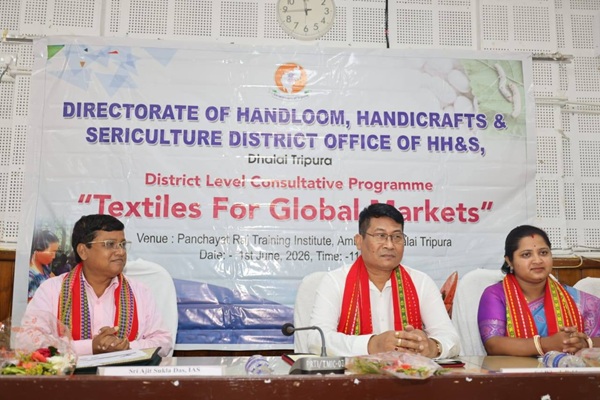
**Ambassa, June 1:** State Tribal Welfare Minister Bikash Debbarma on Monday set an ambitious tone for Tripura’s textile and allied traditional sectors, calling for stronger efforts to take the state’s products to international markets. He was speaking after inaugurating the district-level consultative programme, **“Textiles for Global Markets,”** held at the Panchayat Raj Training Institute in Ambassa, Dhalai.

Debbarma, who lit the ceremonial lamp to formally open the event, highlighted the rich potential of Tripura’s handloom, handicrafts, bamboo, cane and sericulture products. He said these sectors are not only symbols of the state’s cultural identity but also important engines for rural livelihood generation and economic growth.
Addressing artisans, self-help groups, entrepreneurs and officials, the minister urged them to embrace modern technology, improve skill levels and maintain strict quality control so that local products can compete in global markets. He stressed that traditional craftsmanship must evolve in line with changing market demands without losing its heritage value.
“This is not just about preserving tradition; it is about converting heritage into opportunity. With collective effort, Tripura’s artisans can secure a place on the world stage while strengthening rural livelihoods,” Debbarma said.
The programme was organized by the Department of Handlooms, Handicrafts & Sericulture, Government of Tripura, as part of India’s larger target to achieve **US$100 billion in textile exports by 2030**. Officials said Tripura can contribute significantly to this national goal by building stronger market linkages, improving product design, and ensuring export readiness.
The consultative meet saw the participation of several dignitaries, including **Susmita Das, Sabhadhipati of Dhalai Zilla Parishad; Pratima Malakar, Chairperson of Ambassa Municipal Council; Ajit Shukla Das, Director of the Department; and Van Lal Dika Darlong, Additional District Magistrate of Dhalai.**
Discussions during the programme focused on product innovation, branding, export potential and strategies to align traditional industries with global market requirements. Officials underlined that such initiatives would not only boost exports but also empower local communities through sustainable employment and stronger rural incomes.
The event concluded with a renewed call for artisans and stakeholders to modernize practices while preserving Tripura’s distinctive textile identity, ensuring that the state’s heritage products emerge as a globally recognized brand.