




















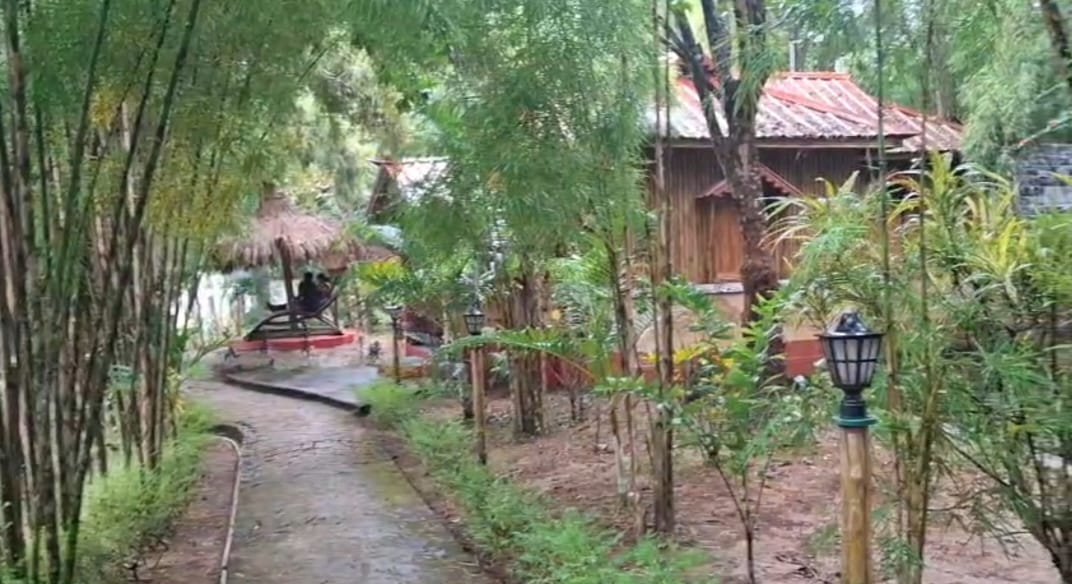
Agartala, Nov 22: Once affected by militant violence, a remote border village in Tripura is gradually transforming itself into a centre for sustainable development, rural tourism and environmental education, using one of the region’s most abundant natural resources — bamboo.

Located at Katlamara, around 46 km from Agartala in West Tripura district, Bashgram is seeking to demonstrate how traditional knowledge, locally available resources and contemporary innovation can create sustainable livelihoods while offering lessons for a world grappling with pollution, environmental degradation and climate challenges.
The transformation carries particular significance for the region. Katlamara and its surrounding villages were once affected by militant activities, with violence and insecurity taking a toll on local communities.
Today, Bashgram is attracting visitors, students and researchers interested in understanding how bamboo can be integrated into everyday life, education, entrepreneurship and environmentally responsible development.
Founded by Manna Roy, a third-generation bamboo farmer and entrepreneur, Bashgram has been developed as a living demonstration of the versatility of bamboo — from household requirements and traditional applications to livelihood generation and sustainable rural practices.
Roy said the initiative was driven by the desire to preserve his family’s three generations of experience in bamboo cultivation and utilisation and pass that knowledge on to younger generations.
The proposed Kathiyaba College of Bamboo Technology and Management is part of this vision, with an emphasis on education, research, technological innovation and entrepreneurship to create new employment opportunities around bamboo.
The initiative is also beginning to attract international interest. A delegation associated with the International Institute for Sustainability in the United States recently visited Bashgram to explore possibilities of collaboration in sustainability education, scientific research and environmental awareness.
Toby Grotz, a former electrical engineer from the United States associated with the institute, expressed interest in working with local institutions to develop sustainability projects and science education programmes.
Grotz also highlighted the relevance of traditional Indian knowledge systems, particularly Vedic wisdom, in contemporary discussions on nature and sustainable living. Referring to the Vedic concept of Akash, he discussed its significance in understanding nature, energy and biological growth.
He also emphasised sustainable agriculture, including perennial cropping systems that reduce the need for repeated soil preparation and annual replanting, potentially helping conserve soil and reduce environmental pressures.
Similar was the views of Srinath Gupta was has been part of the visiting US delegation who said the International Institute for Sustainability, USA, aims to promote Vedic knowledge, Indian traditional wisdom and sustainable science through global academic collaboration. Its programmes in collaboration with the Tripura’s bamboo village is to explore how indigenous technologies, bamboo architecture and traditional practices can offer innovative, pollution-free solutions to contemporary global sustainability challenges.
The proposed international engagement seeks to explore how traditional knowledge and modern scientific research can complement each other in addressing environmental concerns.
Earlier Bashgram has also featured in Prime Minister Narendra Modi’s Mann Ki Baat programme and received a rural tourism award. But its significance extends beyond tourism. For a region once troubled by militancy, the initiative represents an effort to turn local natural resources and inherited knowledge into opportunities for education, entrepreneurship and economic development.
Its larger proposition is that bamboo, when supported by innovation and community participation, can be more than a traditional resource — it can become part of a sustainable development model with relevance far beyond Tripura.