
















Agartala, September 6:

Tripura Leader of Opposition Jitendra Choudhury, who is also a CPI(M) Politburo member, has accused the BJP-led Union government of mounting a widening assault on the rights over land, forests, water, employment, education and cultural identity of Adivasi communities, arguing that the struggle to defend tribal rights has now become a larger battle to protect India’s constitutional character and diversity.
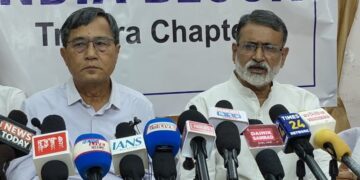
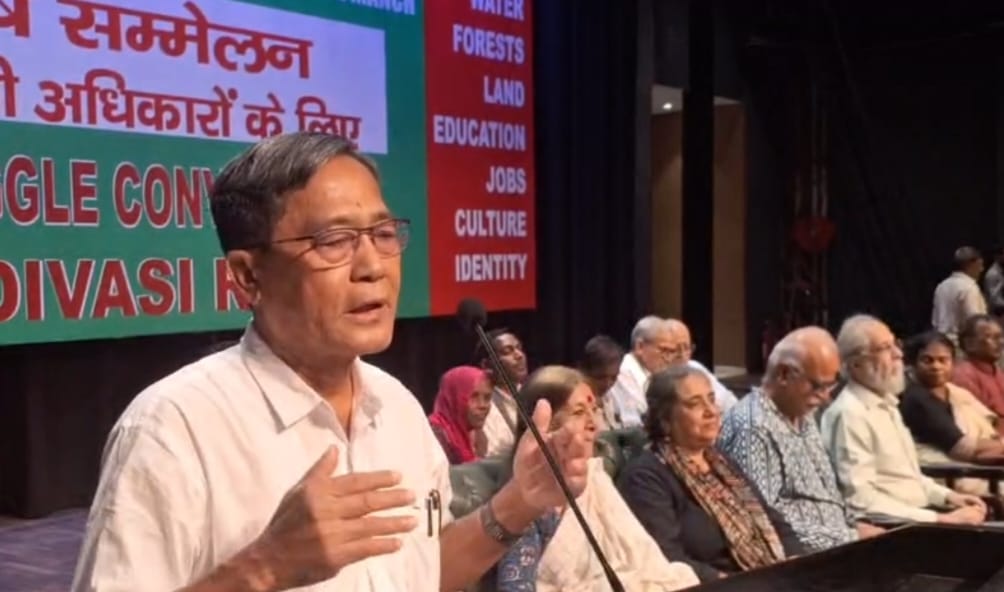
Addressing a national struggle convention for the tribal rights organised by Adivasi Adhikar Rashtriya Manch at the Constitution Club of India in New Delhi, Choudhury said the country was witnessing a systematic erosion of rights won through decades of democratic and social struggles.
He sharply questioned the political narrative of “Atmanirbhar Bharat” and “Viksit Bharat”, saying that development could not be pursued by taking away the natural resources and traditional rights of communities that have historically protected them.
“Everything is being snatched away,” Choudhury said, warning that Adivasis across the Northeast, Gujarat and southern India were facing displacement and losing control over land, forests, minerals and water.
The CPI(M) leader identified displacement, employment, education and identity as the four principal fronts of the present struggle. He alleged that the expansion of mining and other resource-based activities was uprooting tribal communities, while shrinking government employment and the erosion of reservation opportunities were creating another layer of insecurity.
He also expressed concern over the deterioration of educational opportunities, particularly in tribal areas, and said the closure and weakening of schools was directly affecting marginalised communities.
Choudhury warned that the assault was not confined to economic rights. Tribal languages, cultures, beliefs and identities were also under pressure, he said, arguing that India’s diversity itself was at stake.
The conference brought together a substantial gathering of Adivasi activists and Left leaders, particularly from the CPI(M), giving the event a distinctly political character amid growing national debates over land acquisition, forest rights, resource extraction, reservation and tribal representation.
The Adivasi Adhikar Rashtriya Manch has previously framed these issues as a national struggle against land grabs, weakening of Gram Sabha powers, shrinking educational opportunities and attacks on constitutional safeguards for Adivasis.
Choudhury, himself a prominent tribal leader from Tripura, sought to broaden the political meaning of the movement beyond the Adivasi question.
The objective, he said, was “not to defend ourselves alone, but to defend India, our dignity and the diversity of our country.”
His intervention places tribal rights at the centre of the Left’s wider political argument that the current development model is increasingly coming into conflict with constitutional protections, social justice and India’s plural character.