















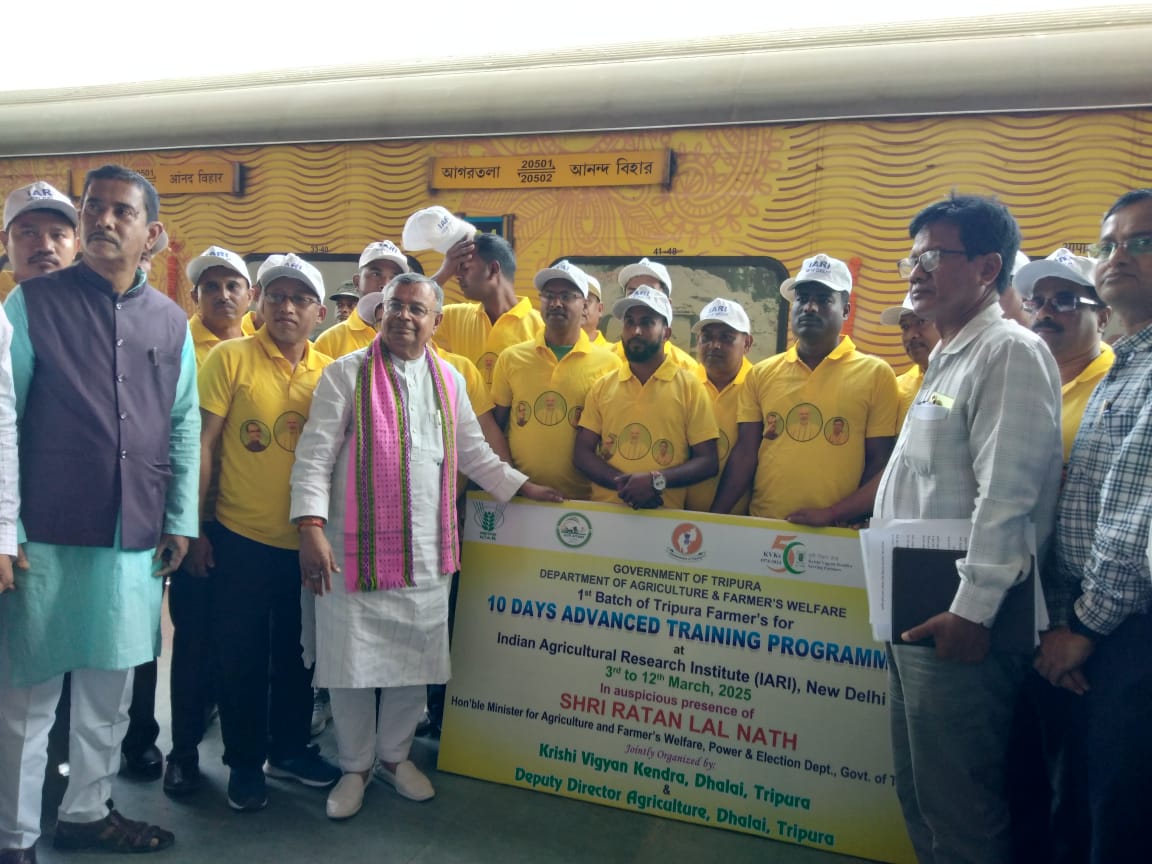
Agartala, March 3: In a major initiative to enhance farmers’ income through modern scientific farming, the first batch of 20 farmers from Tripura left for a 10-day advanced training program at the ICAR-Indian Agricultural Research Institute (IARI) in New Delhi on Monday.

The program aims to equip them with knowledge of advanced agricultural technologies, improved crop varieties, modern farming methods, sustainable pest management, and precision farming techniques.
Tripura’s Agriculture Minister Ratan Lal Nath, along with Agriculture Secretary Apurba Roy and the Directors of the Agriculture and Horticulture departments, saw off the farmers at Agartala railway station.
Nath felicitated the farmers and reiterated the government’s commitment to increasing their income.
Highlighting the progress in agricultural earnings, Nath stated that the current monthly income of farmers in Tripura has risen to over ₹13,000—more than double the ₹6,500 recorded in 2017-18.
He emphasized that the government is working to further boost farmers’ earnings by encouraging the cultivation of high-value crops such as palm oil and mustard, which not only fetch better prices but also contribute to India’s self-reliance in edible oil production.
The Minister further stressed the importance of exposure visits for progressive farmers to enhance their skills. The training program in New Delhi is the first of 10 such batches planned for the state’s farmers.
During the training program, farmers will learn about advanced agricultural technologies, improved crop varieties, modern farming methods, sustainable pest management, and precision farming techniques.
The program will also include direct interactions with agricultural scientists, research center visits, and exposure to various training modules and advanced innovative farming.
This initiative aims to support Tripura’s government farmers by equipping them with knowledge about various agricultural benefits and policies as part of the state’s agricultural development programs.
Additionally during their stay, the farmers will also receive hands-on training on scientific tea cultivation and interact directly with agricultural scientists.
This initiative is part of the state government’s broader efforts to empower farmers with technical knowledge and access to beneficial policies.
Each batch will share their learnings and challenges, enabling the Agriculture Department to devise further improvements and targeted support measures.