
















Agartala, September 17:** For Namita Das of Joyshree Para village, a modest financial support of Rs 1,500 has become the foundation for several small but important decisions for her family — from securing insurance and buying school supplies to starting a poultry activity.

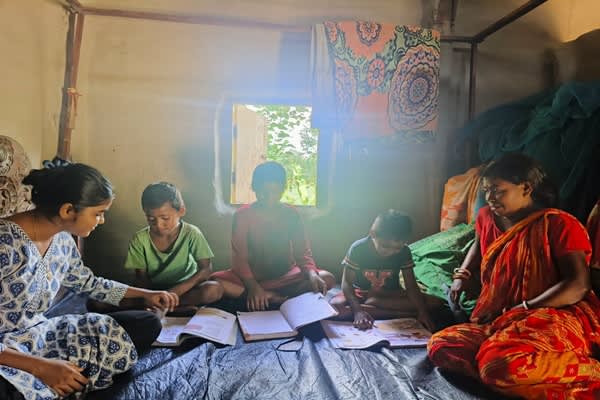
Namita lives in a six-member family with her husband, who works as a daily wage labourer, her elderly mother-in-law Moyna Bala Das and their three school-going children. With the family largely dependent on irregular daily-wage earnings, meeting routine expenses and ensuring that the children have adequate books and stationery has not always been easy.
Her association with the Tripura Rural Livelihood Mission (TRLM) began through the TR-SAY Project. Initially, her mother-in-law was identified to participate in the programme. However, because of her age and health-related difficulties, she was unable to attend meetings regularly.
Namita then began attending the meetings on her behalf. What started as a responsibility to represent her mother-in-law gradually became an opportunity for Namita herself to participate.
Through Small Group Meetings (SGMs), she became increasingly involved in discussions and began gaining a better understanding of financial services and livelihood opportunities. With assistance from a Parivartan Sakhi, she also reactivated her dormant bank account.
The process eventually enabled her to access Rs 1,500 in Community Support Group (CSG) assistance, which she divided among three immediate priorities.
She spent Rs 500 on insurance, enrolling in the Pradhan Mantri Jeevan Jyoti Bima Yojana (PMJJBY) and Pradhan Mantri Suraksha Bima Yojana (PMSBY). Another Rs 600 went towards books and stationery for her children.
The remaining Rs 400 was used to purchase two chickens, providing her with an initial foothold in a small poultry-based livelihood activity.
For Namita, the money has therefore gone beyond meeting immediate needs. It has helped her address her children’s education while also taking her first steps towards creating another source of household income.
“Now my children will also be able to go to school with good books and stationery,” she said.
The programme has also brought a visible change in Namita’s participation at the community level. From initially attending meetings as a representative for her mother-in-law, she now takes part in discussions and speaks with greater confidence.
She has also started preparing a livelihood plan of her own, looking beyond the immediate assistance towards ways of strengthening her family’s financial stability.
Namita’s experience highlights how targeted community support can help women gain access to formal financial services while encouraging greater participation in household economic decisions and livelihood planning.
The changes in her family have not come through a single large investment. Instead, Rs 1,500 has been converted into insurance enrolment, educational materials and two chickens — modest beginnings that Namita hopes will contribute to greater security and more opportunities for her children.