
















Agartala, August 19:

The BJP-led government’s renewed projection of Maharaja Bir Bikram Kishore Manikya Bahadur’s legacy on his 118th birth anniversary has assumed political significance ahead of the TTAADC Village Committee elections, coming amid growing strains within the ruling NDA alliance between BJP-TIPRA Motha party, led by royal scion Pradyot Kishore Debbarma, over the implementation of the Triprasa Accord.
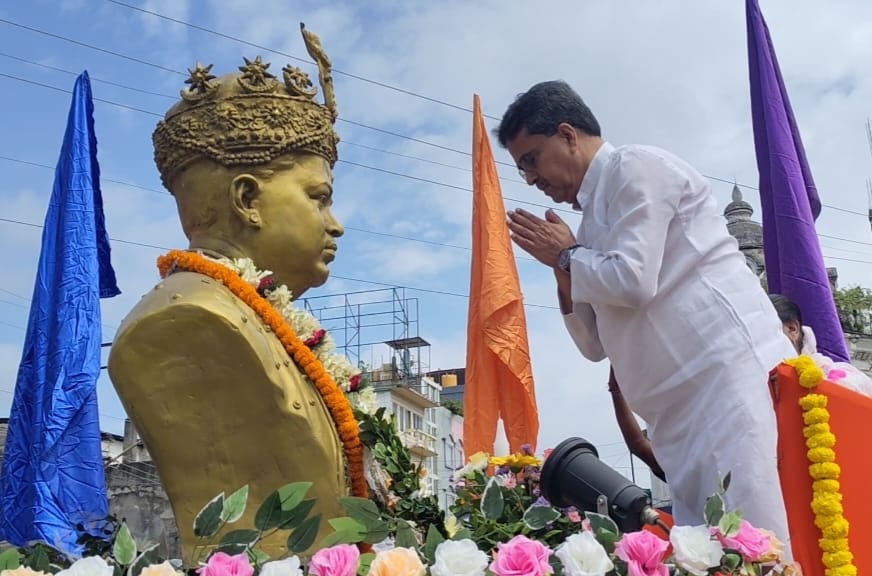
Chief Minister Dr Manik Saha, speaking to reporters on the sidelines of the government programme at Zero Point in Agartala, described Bir Bikram as the “architect of Tripura” and strongly emphasised his contribution to the state’s development, social harmony and modernisation.
The Chief Minister also used the occasion to contrast his government’s approach towards the royal legacy with that of previous governments, claiming that the contributions of the Maharajas had not received adequate recognition earlier.
“Earlier, the names of the Raja and Maharajas were not brought to the forefront,” Saha said, asserting that the BJP government had taken several initiatives to recognise and honour their contribution to the people of Tripura.
The political messaging comes at a crucial juncture. The BJP and its tribal ally TIPRA Motha, are facing differences over the implementation of the Triprasa Accord signed more than two-and-a-half years ago.
With the Village Committee elections approaching, the renewed focus on the royal family’s history and Bir Bikram’s relationship with the state’s population adds another layer to the emerging political narrative.
Saha highlighted the renaming of Singarbil airport after Maharaja Bir Bikram as one of the major initiatives undertaken by the BJP government to honour the former ruler.
He also pointed to the development and preservation of landmarks associated with Bir Bikram in Agartala.
According to the Chief Minister, Bir Bikram’s contribution extended far beyond the capital.
He referred to the Maharaja’s role in developing roads, land reforms and educational institutions across Tripura and said his vision included establishing a university in the state with general, medical and engineering colleges under it. But Saha placed particular emphasis on the Maharaja’s efforts to maintain social cohesion among different communities.
“During his time, he worked to keep the tribal, Manipuri and other communities together,” the Chief Minister said, describing the atmosphere as one of samarasta or social harmony.
That emphasis on unity between different communities assumes significance in contemporary Tripura, where tribal identity, indigenous rights and political representation remain central issues ahead of the ADC elections.
Saha also highlighted the state government’s decision to declare August 19, Bir Bikram’s birth anniversary, a holiday, saying such recognition had not been accorded by previous governments.
He pointed to the location of the anniversary programme itself as another example of the government’s efforts to restore the Maharaja’s legacy. According to Saha, the area had earlier been in poor condition and lacked a significant memorial associated with Bir Bikram. The government subsequently developed the site, raised the landmark associated with the starting point of the old mileage system and installed the Maharaja’s statue.
BJP state president and MLA Abhishek Debroy and Agartala Mayor Dipak Majumder, also a MLA took part in the programme.
The Chief Minister said Bir Bikram’s contribution needed to be remembered by the younger generation and extended greetings to the people on his 118th birth anniversary.
The BJP’s attempt to reclaim and foreground the legacy of the Manikya dynasty comes as the political contest over the ADC is expected to intensify. For TIPRA Motha, whose political appeal is deeply linked to indigenous identity and the legacy of the royal family, the renewed government emphasis on Bir Bikram could also carry wider political implications.
With the BJP-TIPRA Motha alliance under pressure over the Triprasa Accord, the political contest ahead is increasingly acquiring competing narratives around history, identity, indigenous aspirations and the legacy of the former royal house.
The birth anniversary of Bir Bikram, therefore, has moved beyond a commemorative event to become an important backdrop to the evolving political discourse in Tripura ahead of the ADC Village Committee elections.