


















Agartala, August 16:

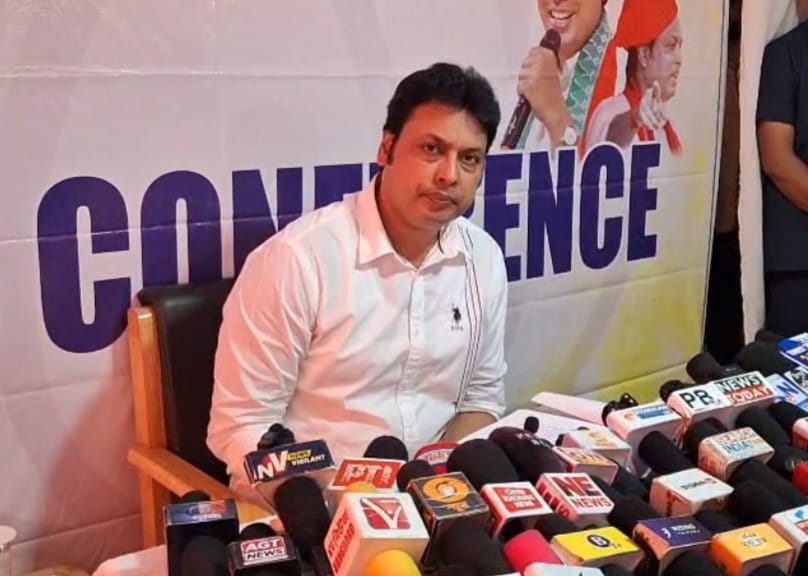
Former Tripura Chief Minister and Lok Sabha MP Biplab Kumar Deb on Sunday expressed serious concern over the deteriorating condition of national highways in the state and questioned the performance of the National Highways and Infrastructure Development Corporation Limited (NHIDCL), saying the agency had failed to discharge its responsibilities properly.
Addressing a press conference in Agartala, Deb said the Centre and the state government were committed to Tripura’s development, but the primary responsibility for construction and maintenance of national highways rested with NHIDCL.
He said the Union government had provided substantial funds for road infrastructure in the Northeast and claimed that around ₹22,000 crore had been sanctioned for road works. The objective behind creating NHIDCL, he said, was to ensure focused and faster development of road infrastructure in the northeastern states.
“If NHIDCL is working across the country, it should be able to focus on the Northeast,” Deb said, stressing that the region required special attention because of its difficult geographical and climatic conditions.
Deb said Tripura faced a particular challenge because the state did not have adequate local sources of stone, unlike several other northeastern states. This, he said, increased the cost of road construction.
Against this backdrop, he advocated construction of concrete roads instead of conventional bituminous roads on important stretches in Tripura. Although concrete roads would cost substantially more initially, he said, they could provide greater durability and reduce the need for repeated expenditure on repairs.
“I have repeatedly told the NHIDCL Managing Director that the work may take some more time, but concrete roads should be constructed. The cost may be higher, but such roads can last for at least 10 years,” Deb said.
He questioned the need for repeated expenditure after roads constructed under earlier contracts had deteriorated. According to him, contractors had completed several packages, but the condition of the roads had subsequently worsened, forcing the authorities to invite fresh tenders on an emergency basis.
Deb said action had also been taken against some contractors and officials in connection with the road works. He referred to contractors being blacklisted and withdrawn from projects, while some packages were being executed through alternative arrangements.
Reacting to criticism from the Opposition that the state government should itself fund repairs of national highways, Deb rejected the argument, saying Tripura did not have the financial capacity to undertake such a massive responsibility.
“Tripura’s total budget is around ₹37,000 crore. How can the state government spend ₹22,000 crore on roads?” he asked.
He said the state Public Works Department (PWD) also did not presently have the manpower, infrastructure or institutional capacity to take over all NHIDCL projects. If the responsibility were transferred to the PWD, he said, its engineering strength, offices and overall capacity would first have to be substantially expanded.
Deb also recalled that during his tenure as Chief Minister, the PWD had initially been brought into the process for certain road projects, including the Agartala-Jirania stretch, before the work was subsequently handed over to NHIDCL.
Deb acknowledged that some major road projects had taken considerably longer than expected, saying the Agartala-Jirania road had remained incomplete for years.
“I myself am saying that this road has not been completed even after four years; the Opposition does not need to say it,” he said.
He said alternative execution models involving large infrastructure companies had also been considered during his tenure. He recalled discussions with major companies, including L&T, but said such companies had indicated that they would consider projects only above a certain financial threshold because they relied on their own machinery and infrastructure rather than extensive subcontracting.
Despite his criticism of NHIDCL, Deb said the immediate priority was to restore the roads rather than engage in a blame game.
“Whatever has happened—good or bad—is before you. It is our responsibility to fix it,” he said, referring to himself and Chief Minister Dr Manik Saha.
Deb said he was personally concerned about the condition of the highways and assured the people of Tripura that efforts would be made to ensure that the damaged stretches were repaired at the earliest.
He said the government was now considering fresh packages and, wherever necessary, durable concrete construction rather than merely undertaking temporary repairs.
Deb also referred to a pilot concrete road project in the Amarpur area, saying such projects could demonstrate the viability of concrete construction in Tripura’s conditions.
“I want to assure the people through you that we will get these roads fixed,” Deb said, adding that he had personally witnessed the difficulties faced by commuters while travelling on the damaged stretches.
His remarks came amid growing public and political concern over the condition of several national highway stretches across Tripura, with the issue increasingly emerging as a major infrastructure concern in the state.