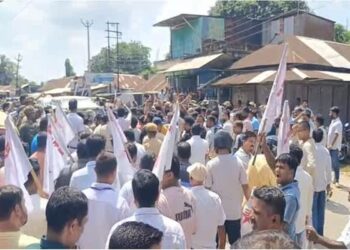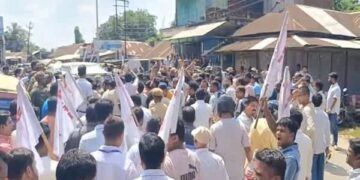















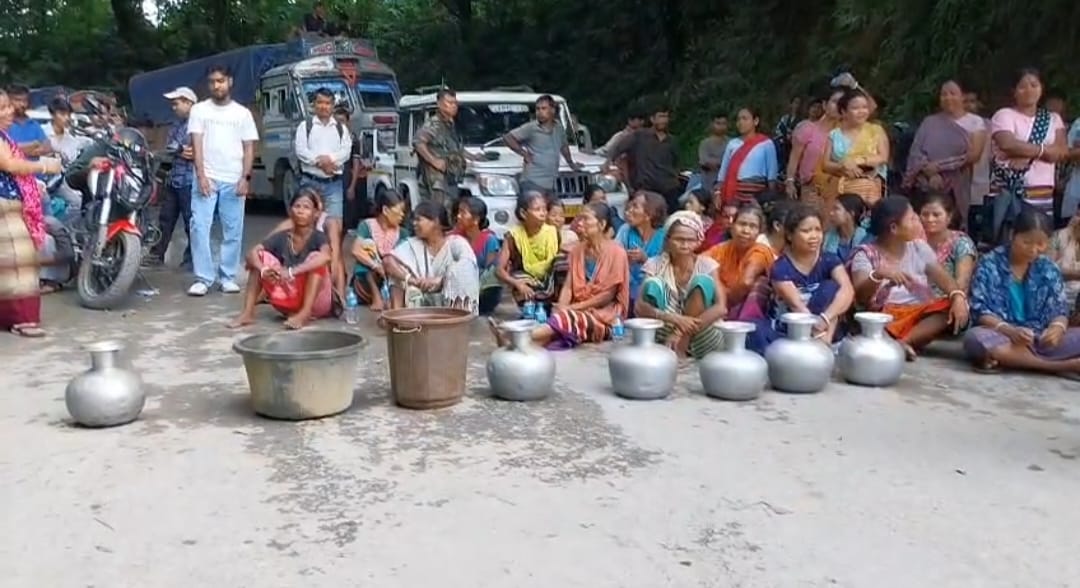
Agartala, August 11: A severe drinking water crisis persisting for nearly a week triggered a major road blockade on Tuesday, as hundreds of villagers, including a large number of indigenous women, blocked the Assam-Agartala National Highway at 36 Mile in Krishnapur area under Khowai district of Tripura, disrupting traffic on the state’s lifeline highway for nearly four hours.

The blockade brought traffic to a standstill on both sides of the highway, leaving a long queue of passenger and goods vehicles stranded.
Tripura’s Higher Education and Panchayat Minister Kishore Barman was also caught in the traffic snarl along with scores of commuters and truck operators.
The protesters alleged that drinking water supply to the area had remained completely disrupted for several days despite repeated complaints to the authorities.
Residents said that more than 300 families were being forced to travel long distances in search of water, with the prolonged crisis severely affecting children, elderly people and those suffering from illness.
The Public Health Engineering Department (DWS), however, attributed the immediate crisis to a malfunctioning pumping machine, saying repeated attempts to repair and restart the system had failed.
A DWS official who spoke to reporters said the department’s maintenance team had repaired the machine and reloaded it, but it stopped functioning again within five to ten minutes of being restarted. Repair work on the machine was still underway when the blockade took place, the official said.
The department claimed that tanker services were available as an alternative arrangement. However, the official acknowledged that the protesters were demanding that water be delivered to every household, something the department was finding difficult because tanker vehicles require adequate road access to reach individual homes.
The explanation failed to satisfy the villagers, who insisted that tanker-based arrangements could not substitute for regular piped drinking water supply.
Following the blockade, personnel from Mungiakami police station reached the spot to control the situation.
DCM Sandeep Debbarma of the sub-divisional administration and officials of the DWS also arrived and held discussions with the protesters.
The protesters maintained that the problem was not merely a temporary technical failure but the result of an inadequate and unreliable water supply system. They demanded immediate restoration of regular supply and a permanent solution to prevent the crisis from recurring.
The blockade was lifted after nearly four hours following assurances from the administration and the concerned department that steps would be taken to restore the water supply and address the underlying problem.
Normal traffic subsequently resumed on the highway, but the villagers warned that the agitation could intensify if the authorities failed to ensure regular drinking water supply.
The protesters, however, warned that the withdrawal of the blockade was only temporary and they would launch a larger agitation if the authorities failed to resolve the water crisis within a reasonable time.
The incident also underscored the widening gap between the government’s tanker-based emergency response and the villagers’ demand for a dependable household-level drinking water supply, with residents making it clear that temporary relief would not resolve the crisis.