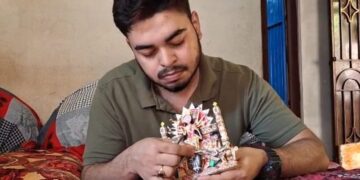















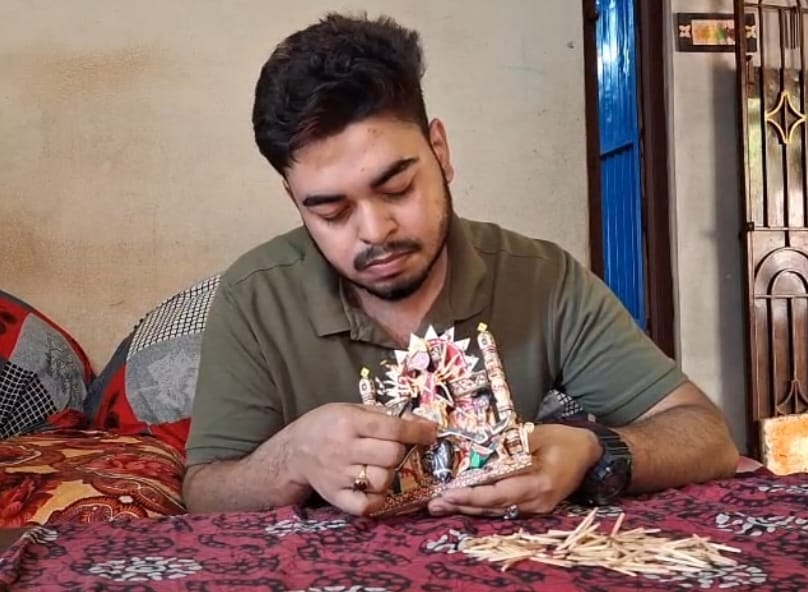
Agartala, October 13: As Tripura prepares to celebrate Durga Puja, an art teacher in Agartala is giving a creative twist to the festive spirit by transforming discarded matchsticks and ice cream sticks into miniature works of art, including an intricate idol of Goddess Durga.

Bijoy Debnath, a resident of Chanmari in Agartala, has turned an idea born during the COVID-19 lockdown in 2020 into an artistic pursuit that promotes recycling, creativity and environmental awareness.
His latest creation, a miniature of Goddess Durga made using around 700 matchsticks, ice cream sticks and small quantities of paper, took him five days to complete.
The artwork reflects how ordinary household waste can be transformed into decorative pieces through patience, imagination and craftsmanship.
“I got the idea during the lockdown when I saw my mother using matchsticks to light the cooking fire. Some of the sticks were only partially burnt and were thrown away. I began wondering whether these discarded materials could be reused to make something useful,” Debnath said who could not complete his art degree due to poverty.
That initial thought gradually developed into a series of miniature creations. Along with matchsticks, he began collecting used ice cream sticks, washing and drying them before incorporating them into his work.
Over time, his creations expanded beyond religious figures to include temples, architectural landmarks and decorative objects. Among his works are a miniature of the Tripura Sundari temple, the Taj Mahal and representations of other prominent landmarks, including the Ram Mandir, London Bridge, the Statue of Liberty and the Statue of Unity. He has also created an image of Prime Minister Narendra Modi.
For Debnath, the exercise goes beyond artistic expression. He believes reusing discarded materials can help reduce waste and encourage people, particularly children, to adopt environmentally conscious habits.
As an art teacher, he has also begun encouraging his students to explore recycling through painting and craftwork, using materials that might otherwise end up in the garbage.
“I teach my students how to make things from matchsticks and ice cream sticks. I encourage them to collect and reuse such materials rather than throw them away,” he said.
Debnath believes the practice can benefit both individuals and society by combining creative learning with responsible waste management.
His work offers a simple message during the festive season: creativity need not depend on expensive materials, and objects considered waste can acquire a new purpose when viewed through the lens of imagination.
As his matchstick creations bring familiar religious figures and landmarks to life in miniature form, Debnath hopes to inspire more people to discover the artistic possibilities hidden in everyday discarded items.