

















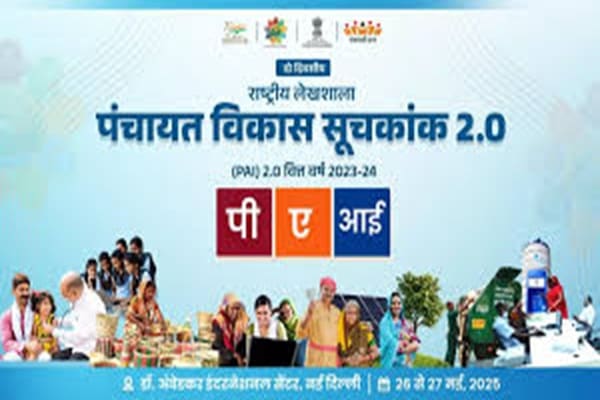
Tripura’s grassroots governance institutions have earned significant national recognition with the release of the Panchayat Progress Index (PPI) 2.0 by the Ministry of Panchayati Raj on the occasion of National Panchayati Raj Day. Demonstrating strong participation and consistent performance, all 1,176 Gram Panchayats in the state contributed to the assessment, placing Tripura among the country’s notable performers in rural governance.

According to the 2023–24 report, a total of 3,635 Panchayats across India were graded as Front Runners (Grade A), while nearly 1.18 lakh were categorized as Performers (Grade B). Within this competitive national landscape, Tripura’s Panchayats stood out for their achievements across key sectors such as poverty alleviation, healthcare, sanitation, infrastructure development, and transparent governance practices.
A major highlight of the report is the recognition of Jugal Kishore Nagar Panchayat in Sepahijala district’s Jampuijala subdivision, which has been acknowledged as one of the best-performing Panchayats in the country. Its performance reflects effective planning, community participation, and efficient implementation of development schemes at the grassroots level.
In addition to this, several Panchayats from Tripura received top thematic rankings for excellence in specific areas. Shibnagar in Sepahijala district was recognized for promoting poverty-free livelihoods, while Paschim Sarbang in Gomati district excelled in healthcare services. Kanchanbari in Unakoti district was honoured for its child-friendly initiatives, and Uttar Dhanicherra, also in Unakoti, was noted for achieving water sufficiency.
Other notable performers include Paschim Takarjala in Sepahijala for its clean and green initiatives, Uttar Taichama in South Tripura for infrastructure development, Thakchhara in Gomati for good governance, Paharpur in Gomati for social security measures, and Baikunthapur in West Tripura for its women-friendly initiatives.
Officials stated that this recognition reflects Tripura’s sustained efforts to strengthen democratic institutions at the village level and promote inclusive, sustainable development. The PPI 2.0 results not only highlight the state’s progress but also position it as a model for participatory governance, combining accountability, innovation, and community empowerment.