
















Agartala, February 11:

Union Minister for Agriculture & Farmers Welfare and Rural Development Shivraj Singh Chouhan on Wednesday heaped praise on Tripura’s “exceptional” performance in rural development, declaring the state a model for the country under the Centre’s Viksit Bharat Gram Yojana (G-RAM-G Act 2025), while launching a sharp political attack on the Congress for what he termed “decades of misgovernance and misleading politics.”
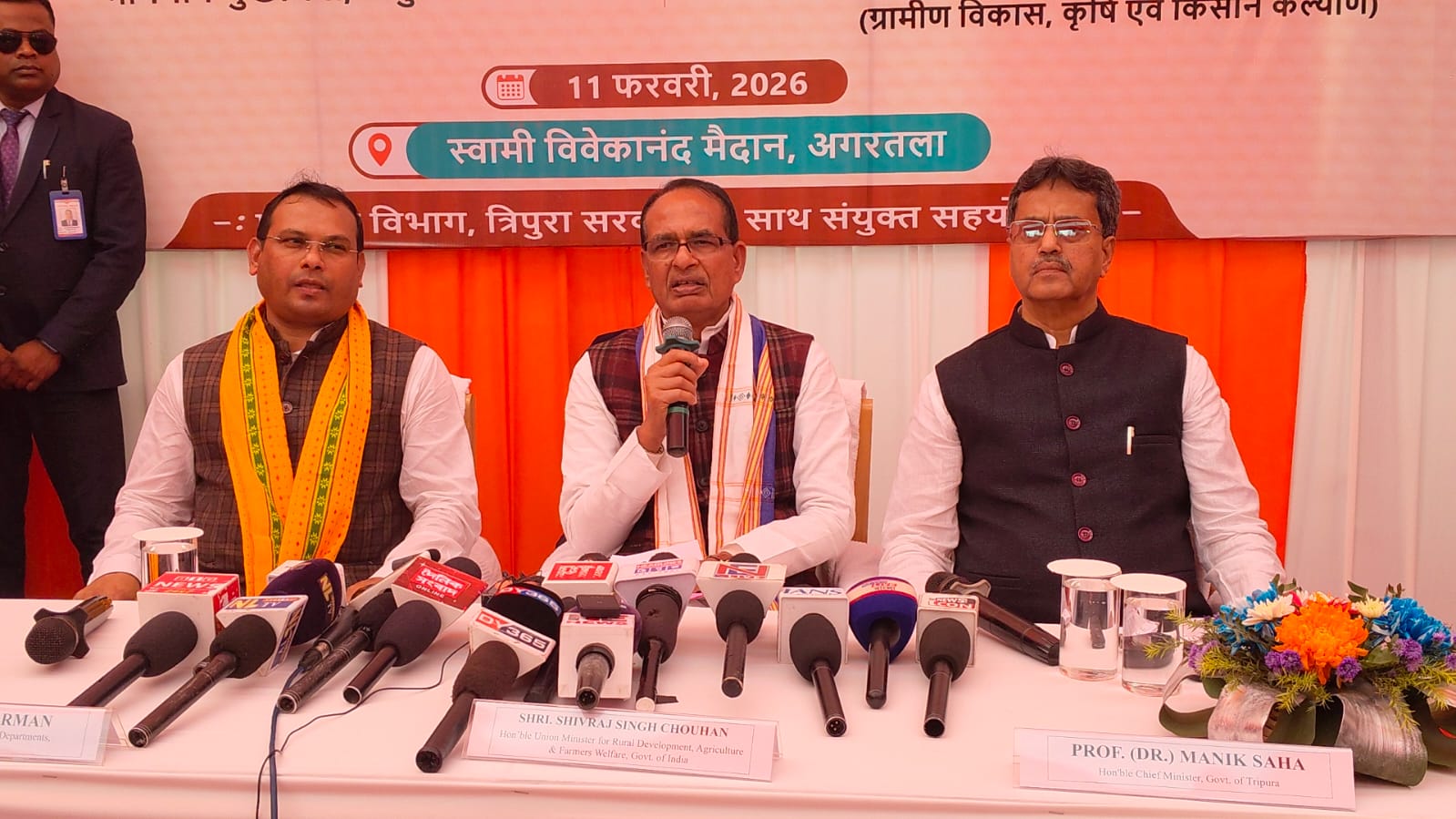
After addressing the gathering at the Public Representatives’ Conference on Viksit Bharat G-RAM-G Act 2025, the Union Minister visited multiple stalls at Swami Vivekananda Maidan showcasing rural development initiatives, self-help group enterprises, agricultural innovations and livelihood projects. He later addressed a press conference.
“Tripura has delivered an excellent performance. I wholeheartedly congratulate the state government,” Chouhan said.
Highlighting achievements, he noted that under the Pradhan Mantri Awas Yojana (PMAY), Tripura had a target of constructing 3,06,913 houses, but has already sanctioned and completed 3,45,828 houses, achieving more than 99 percent completion, making it the only state in the country to surpass its target.
He further said the state has made remarkable progress in rural roads under PM Gram Sadak Yojana and women’s economic empowerment. Over 1.08 lakh women have become ‘Lakhpati Didis’, exceeding the set target.
Calling the Viksit Bharat Gram Yojana a transformative initiative, Chouhan said employment opportunities under the rural job scheme will be expanded from 100 days to 125 days, backed by a substantial increase in funding.
“The earlier allocation of ₹86,000 crore has now been enhanced to ₹1,51,282 crore jointly by the Centre and states. With this, villages will see faster development and assured employment,” he said.
The Union Minister, in presence of Tripura Chief Minister Dr Manik Saha and Panchayat Minister Kishore Barman stressed that unlike earlier systems, decision-making powers will now rest with Gram Sabhas, allowing villagers to determine priorities such as roads, ponds, bridges, check dams, schools and Anganwadi centres.
“If wages are delayed, compensation will be paid. Administrative expenditure has also been raised to ensure smooth implementation,” he added.
To strengthen Tripura’s agriculture sector, Chouhan announced that ICAR scientists and experts will soon conduct a comprehensive study of the state’s soil, water resources and agro-climatic conditions to prepare a roadmap aimed at doubling farmers’ income.
He praised Tripura’s pineapples, indigenous potato varieties and aromatic lemons already being exported, and advocated integrated farming including agarwood, sandalwood, livestock, fisheries, goat rearing and beekeeping to boost earnings of small farmers.
The Centre has approved ₹60 crore additional funds under RKVY, besides support for paddy, fisheries and pulse production. Nearly two lakh more eligible rural families will also receive houses in phases under PMAY, he said.
Under the fourth phase of PM Gram Sadak Yojana, the Centre is set to approve connectivity for 108 more villages.
Targeting the Congress, Chouhan accused the party of politicising welfare schemes and creating confusion.
“Congress named schemes after their own family members instead of Mahatma Gandhi. They kept changing names — Jawahar Rozgar Yojana, NREGA, MGNREGA. They spread misinformation. Congress has become a shop of lies and a market of rumours,” he alleged.
Chouhan said the BJP-led government, under Prime Minister Narendra Modi, is committed to inclusive development, describing the Northeast as the Prime Minister’s ‘Ashtalakshmi’, with special focus on connectivity, agriculture, handicrafts and trade.
“India’s future is bright, and Tripura is progressing rapidly under the Chief Minister’s leadership. The Agriculture and Rural Development Ministry will leave no stone unturned for the state’s development,” he added.
The conference witnessed participation of Panchayat representatives, officials and stakeholders from across the state, showcasing Tripura’s growing role in India’s rural transformation under the Viksit Bharat vision.