



















Agartala, December 4:

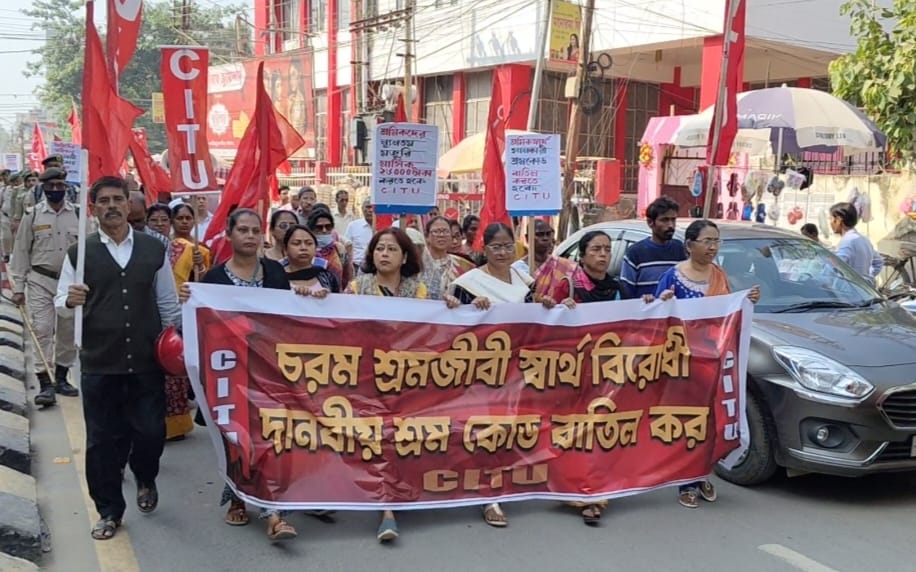
Responding to a nationwide call by the Centre of Indian Trade Unions (CITU), hundreds of workers, employees and supporters from various sectors on Thursday took to the streets of Agartala demanding the immediate repeal of what they termed the Centre’s “anti-worker, pro-corporate” labour codes.
Protesters marched through the city carrying red flags — symbolic of the working-class struggle — and banners denouncing the four newly implemented labour codes.
They raised slogans accusing the Centre of curtailing workers’ rights and strengthening corporate interests at the cost of labour welfare.
CITU leaders said the central government appeared emboldened by the Bihar election results and warned that the working class would intensify its fight through organised, united struggles in the days to come.
The four labour codes — the Code on Wages (2019), the Industrial Relations Code (2020), the Code on Social Security (2020), and the Occupational Safety, Health and Working Conditions Code (2020) — were officially enforced on November 21, 2025.
While the Centre claims the new laws will usher in transformational change by ensuring better wages, safety, social security and welfare for workers, trade unions argue that the reforms are designed to favour corporates and weaken labour protections.
Former CPIM MP and CITU Tripura general secretary Sankar Prasad Datta, speaking to reporters, explained the background behind repealing 29 existing labour laws and replacing them with the four codes.
He alleged that the laws were passed during 2019 and at the peak of the Covid-19 pandemic in 2020 in order to “serve corporate interests”.
Datta further claimed that many benefits traditionally enjoyed by workers would be curtailed once the new codes come into effect.
Senior CPIM and CITU leaders, including the leftist trade union’s state president and former Minister Manik Dey, also joined the rally, which began at the CITU state headquarters at Office Lane and culminated at Orient Chowmuhani, where the leaders addressed a mass gathering.
Last week, India announced the countrywide enforcement of what many experts describe as the most far-reaching labour reforms in decades. The overhaul has merged 29 central labour laws into four simplified codes, reducing the number of labour rules from around 1,400 to nearly 350 and cutting compliance-related forms from 180 to 73 — significantly easing the regulatory burden on businesses.
The laws were passed by Parliament in 2020, but their nationwide implementation comes after five years of political deliberation and resistance from states and unions.
Trade unions, however, described the move as a ‘fraudulent deception perpetrated by the Centre against the working people of the country to benefit corporates’ and are demanding a complete rollback, claiming the codes represent the most aggressive dilution of workers’ hard-earned rights since Independence.