


















*Fatikroy, Unakoti:*
As Poush Sankranti approaches, the village of Gokulnagar in Fatikroy is once again filled with the sights, sounds and aromas of preparing tillai and batasha—the traditional sweets inseparable from the festival. For Hindu Bengalis, Poush Sankranti, also observed as Makar Sankranti, is a deeply significant occasion marked by household rituals, nagar kirtans and the popular ‘Harir Loot’, where these sweets occupy a central place.

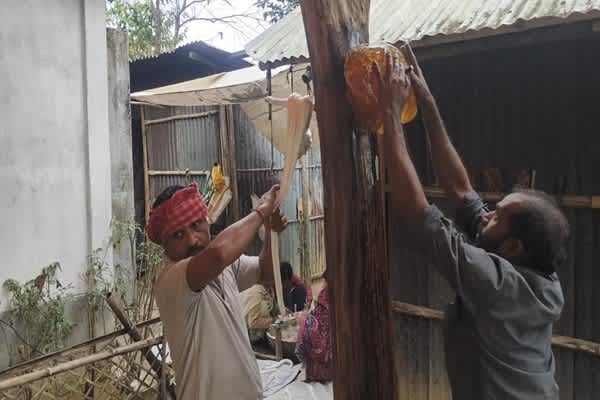
Inside the modest workshop of veteran artisan Ramapada Pal, the festive rush is evident. Family members of all ages are busy shaping, boiling and moulding the sweets in a scene that reflects decades of inherited skill. His mother, Anjali Pal, now in her sixties, said she has been associated with the craft since she was 15. For more than seventy years, the Pal family has preserved this tradition, passing it from one generation to the next.
“Earlier we worked from dawn till late night during Sankranti,” Anjali recalled. “Age has slowed me now, but I still join my children and grandchildren to keep our family tradition alive.”
Despite steady demand during the festive season, the artisans face increasing difficulties. Ramapada Pal pointed to a growing shortage of workers, saying younger generations are reluctant to learn the labour-intensive craft. “Only two outside labourers assist us now, along with family members. It is uncertain how long we can continue,” he said.
The occupation, once the family’s main livelihood, is no longer as rewarding. Preparations that once began six weeks before Sankranti now start barely two weeks in advance. Rising labour costs, reduced public curiosity and changing lifestyles have made survival difficult for traditional sweet-makers.
Still, the spirit of Sankranti endures. In Gokulnagar, women, men and children come together every year to preserve this cultural legacy. The aroma of jaggery and sesame, the rhythmic clatter of utensils and the collective effort of families stand as a quiet resistance against fading traditions.
As Poush Sankranti draws near, these artisans continue their struggle—not merely to produce festive sweets, but to protect a heritage deeply woven into the cultural fabric of Unakoti.